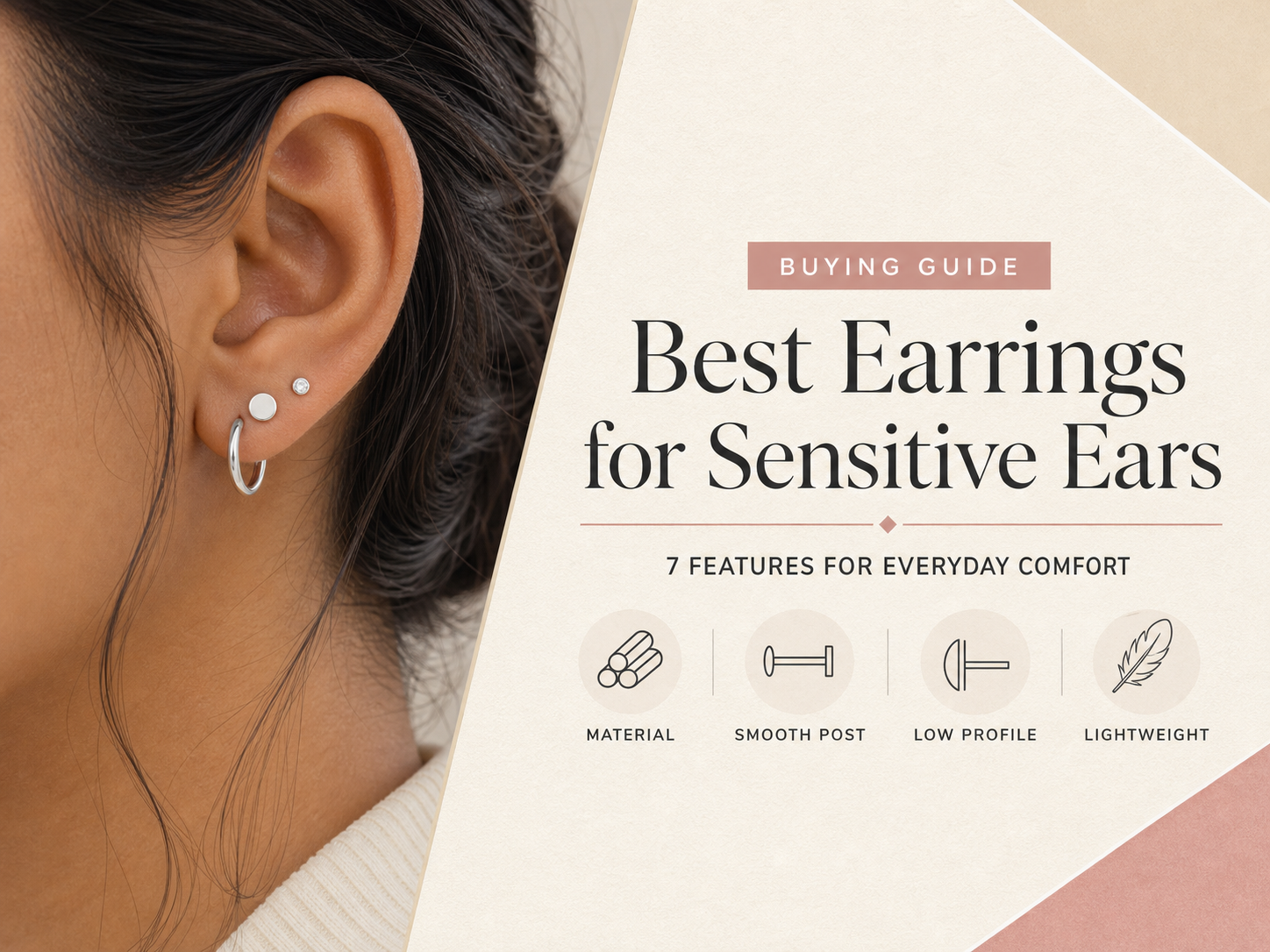
If earrings feel fine for an hour but leave your ears itchy, warm, or sore by the end of the day, the problem may not be the design. Material, post finish, backing shape, fit, and even the way a piece moves can all affect sensitive ears.
This shopping guide focuses on the practical details that help earrings feel easier to wear. It is written for healed piercings and everyday jewelry choices. If your piercing is new, swollen, painful, or producing unusual discharge, ask a qualified piercer or healthcare professional for individual advice before changing jewelry.
Why do some earrings irritate sensitive ears?
Nickel is a common trigger for allergic contact dermatitis, and earrings and earring backs are frequent sources of exposure. The American Academy of Dermatology advises people with nickel allergy to avoid items that contain the metal.
But material sensitivity is only one possibility. Pressure from a tight backing, friction from a rough post, trapped moisture, heavy earrings, or jewelry that shifts while you sleep can also make a healed piercing feel uncomfortable.
The seven features that matter most
1. Clearly identified metal
Look for an exact material description instead of relying only on phrases such as “skin friendly” or “hypoallergenic.” For people concerned about nickel sensitivity, documented implant-grade titanium is a widely preferred option because it is lightweight and can meet recognized implant standards.
The Association of Professional Piercers lists ASTM F-136, ASTM F-1295, ISO 5832-3 and ASTM F-67 among the relevant titanium standards used for piercing jewelry. For a deeper comparison of titanium, silver, plating and nickel, read our piercing jewelry materials guide.
2. A smooth post
The part that passes through the piercing should feel polished and free from burrs, rough seams, or exposed external threading. A smooth post reduces unnecessary scraping when jewelry is inserted or removed.
3. A low-profile backing
A flat-back labret sits close to the rear of the ear instead of leaving a long post or pointed component exposed. Many people prefer this shape for daily wear, especially in cartilage placements where a bulky backing can catch on hair, clothing, headphones, or a pillow.
4. Room without excess length
Jewelry should not pinch, but an unnecessarily long post may move, tilt, and snag. The best length depends on your anatomy and whether the piercing is still healing. A professional piercer can measure the area and downsize jewelry at the appropriate stage.
5. Lightweight design
Large decorative fronts can pull on the channel even when the metal itself is well tolerated. For long wear, begin with small studs, delicate hoops, or balanced clusters that do not drag the piercing downward.
6. Secure construction
Internally threaded and threadless designs keep the wearable surface comparatively smooth. Check the closure regularly according to the maker’s instructions, but avoid repeatedly twisting jewelry in a healing piercing.
7. A style suited to the placement
An earring that works in a lobe may not be the best shape for a helix or tragus. Placement-specific jewelry helps keep pressure, movement, and snagging under control. Explore pieces by location, including helix jewelry, conch jewelry, tragus jewelry, and stacked-lobe jewelry.
Which materials are worth considering?
| Material | Why people choose it | What to verify |
|---|---|---|
| Implant-grade titanium | Lightweight and suitable for people concerned about nickel sensitivity | Documented ASTM or ISO grade and a polished finish |
| 925 sterling silver | Classic color and broad style selection for healed piercings | Alloy disclosure, tarnish care, and personal tolerance |
| Biocompatible solid gold | Precious-metal option with a warm finish | Nickel- and cadmium-free alloy; not plated, filled, or vermeil for a fresh piercing |
| Unspecified plated metal | Accessible fashion finish | The coating can wear and expose the base metal |
Flat backs, hoops, or butterfly backs?
For a small everyday stud, a flat back often offers a cleaner, lower-profile feel behind the ear. A properly sized hoop can also be comfortable in a fully healed placement, but movement and diameter matter. Butterfly backs are familiar and convenient for occasional lobe earrings, although their shape can trap buildup and the exposed post may poke during sleep.
Read our full flat-back vs butterfly-back comparison before choosing a backing style.
A simple comfort check before buying
- Is every skin-contact component clearly identified?
- Is the post smooth and appropriately thick?
- Will the backing sit flush without compressing the ear?
- Is the decorative front light enough for extended wear?
- Is the style intended for your piercing placement?
- Can the jewelry be cleaned without damaging its surface?
What to do if earrings still cause a reaction
Remove fashion earrings from a healed piercing if they repeatedly cause itching or a rash, and avoid wearing the same material until the cause is clearer. A dermatologist can diagnose allergic contact dermatitis, while a professional piercer can assess jewelry fit, finish, and placement.
Seek prompt medical care if symptoms include spreading redness, increasing warmth or pain, fever, or thick yellow or green discharge. Do not remove jewelry from a suspected infected piercing without professional advice.
Frequently asked questions
Are titanium earrings good for sensitive ears?
Documented implant-grade titanium is lightweight and is commonly recommended for people concerned about nickel sensitivity. Verify the grade and surface finish rather than relying on the word “titanium” alone.
Is 925 silver always nickel-free?
No. Sterling silver contains 92.5% silver and 7.5% other metals, and the alloy composition can vary. Ask the seller for clear material information and use sterling silver in fully healed piercings if your skin tolerates it.
Can heavy earrings make sensitive ears sore?
Yes. Weight and leverage can irritate a piercing even when the metal is well tolerated. Choose smaller, lighter jewelry for all-day wear.
Should sensitive ears sleep in earrings?
Fresh piercings generally need jewelry left in place, but the style and fit should be selected by a professional piercer. For healed piercings, a low-profile flat back may feel less intrusive than a long post or bulky butterfly back.
This article is for general education and shopping guidance only. It is not a substitute for medical diagnosis, treatment, or individualized piercing advice.