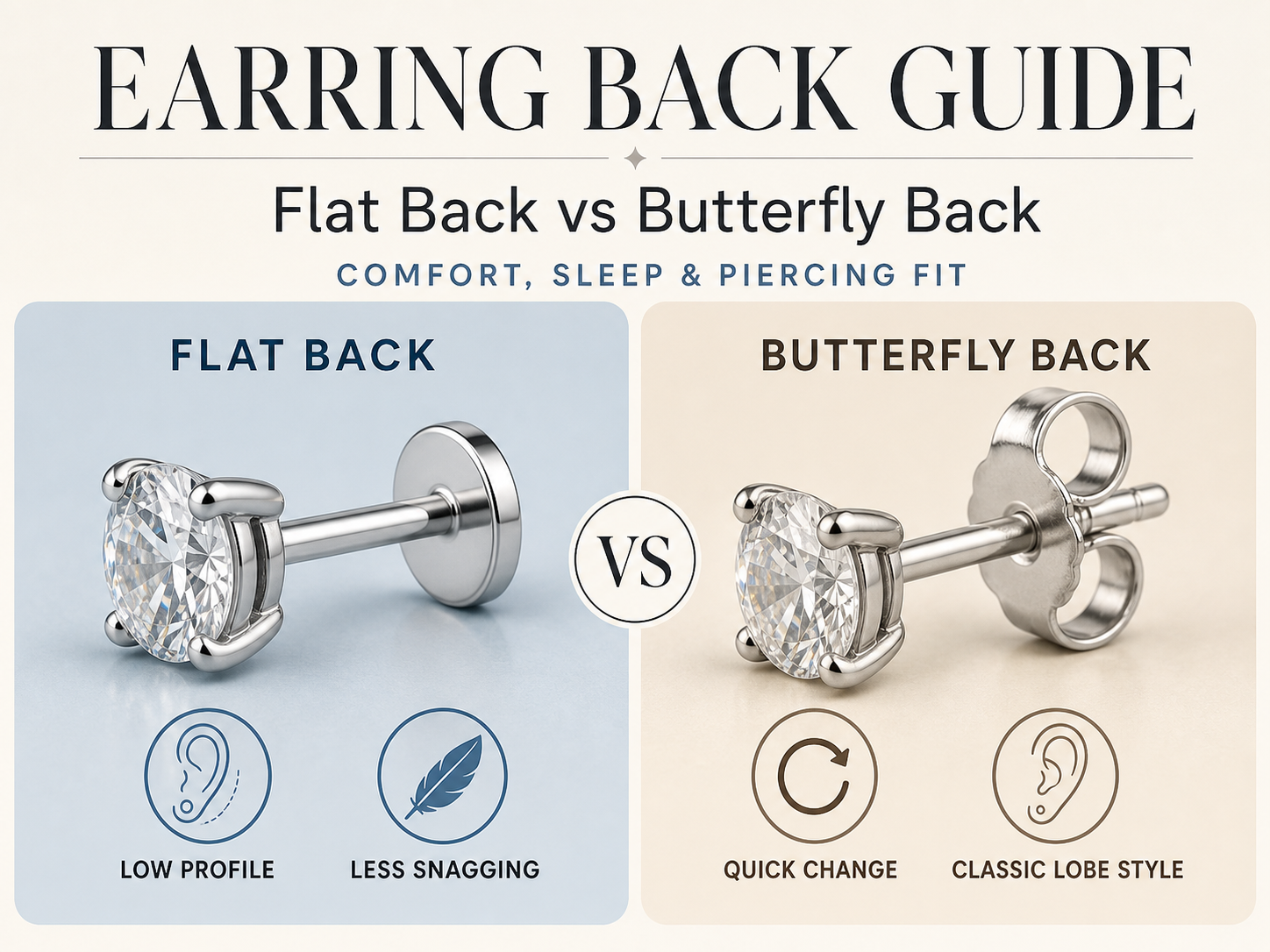
An earring backing is easy to overlook until it presses into your neck, catches a strand of hair, or feels uncomfortable against a pillow. Flat-back and butterfly-back earrings secure jewelry in very different ways, and the better choice depends on placement, fit, lifestyle, and whether the piercing is healed.
This guide compares their construction and daily-wear experience without treating one design as universally right for every ear.
Quick comparison
| Feature | Flat-back earrings | Butterfly-back earrings |
|---|---|---|
| Rear profile | Flat disc sits close to the ear | Wing-shaped clutch sits on an exposed post |
| Typical placements | Lobes and many cartilage placements | Mostly healed lobe piercings |
| Sleeping comfort | Lower profile when properly fitted | Post or clutch may press into the skin |
| Snagging | Less exposed hardware | Clutch and post can catch hair or fabric |
| Cleaning access | Simple surfaces but fit must not be too tight | Small spaces in the clutch can collect residue |
| Convenience | Threadless or threaded closure may take practice | Familiar push-on closure for quick changes |
What is a flat-back earring?
A flat-back earring, often called a labret, uses a smooth post with a small disc on the rear. The decorative end is attached from the front and may be internally threaded or threadless.
The Association of Professional Piercers notes that internally threaded jewelry keeps the portion passing through tissue smooth, while threadless jewelry is another acceptable closure style for initial piercings when the material, size, and finish are appropriate.
What is a butterfly-back earring?
A butterfly back is a small clutch with two curved wings that slides onto a straight earring post. It is common in traditional fashion studs and allows fast removal and replacement.
The clutch can be moved along the post, but pushing it too tightly may compress the ear and reduce space for normal cleaning. The exposed point of the post may also be noticeable when lying down.
Which backing is more comfortable for sleeping?
A properly sized flat back usually has the advantage because the rear disc is smooth and low profile. It removes the pointed post end that commonly pokes behind a butterfly clutch.
However, no backing makes it a good idea to put constant pressure on a healing cartilage piercing. The APP body-piercing aftercare guidance warns that sleeping directly on healing cartilage can cause irritation and may even shift the piercing angle. A travel pillow or side-sleeping pillow with an ear opening can help keep pressure off the area.
Which backing is better for cartilage piercings?
Helix, flat helix, conch, and tragus placements often benefit from a low-profile labret selected for the individual anatomy. Flat backs reduce exposed hardware and can work with small decorative ends.
Initial jewelry still needs enough length to accommodate swelling. Later, a professional piercer may recommend downsizing to reduce movement and snagging. Browse styles by placement, including helix, flat helix, conch, and tragus jewelry.
Which is easier to keep clean?
Both styles require clean hands and gentle care. A butterfly clutch has grooves, folds, and a narrow channel that can collect cosmetic residue, hair products, and skin oils. A flat disc has a simpler shape, although jewelry fitted too tightly can trap moisture and place pressure on the tissue.
For a healing piercing, follow the care plan from your professional piercer. The APP aftercare guidance recommends sterile saline wound wash and discourages unnecessary twisting or rotation.
Does the backing affect sensitive ears?
Yes, because the backing is in prolonged contact with skin. The decorative front may be well tolerated while a different alloy in the clutch triggers itching or a rash. The American Academy of Dermatology identifies earrings and earring backs as common sources of nickel exposure.
Check the material of the post, front, and backing—not just the color of the jewelry. Our sensitive-skin material guide explains how titanium, 925 silver, plating, and nickel differ.
When butterfly backs still make sense
Butterfly backs remain practical for healed lobe piercings, occasional statement earrings, and people who like to change fashion jewelry quickly. They are easy to recognize and widely available.
Use them with enough space behind the lobe, keep the clutch clean, and avoid sleeping in long or pointed posts. If the earring feels tight, heavy, or unstable, change the fit rather than forcing the backing closer.
When flat backs are worth the switch
- You want a lower-profile backing for everyday wear.
- Your current posts poke behind the ear.
- Hair, masks, or clothing frequently catch the clutch.
- You wear jewelry in a helix, conch, tragus, or stacked-lobe placement.
- You want interchangeable decorative ends on compatible posts.
For fully healed piercings, an insertion taper may help guide compatible flat-back jewelry, but it should never be used to create a piercing. See Aurivna’s titanium flat-back insertion and ball-grabber tool set for jewelry handling, and seek professional help if insertion causes pain or resistance.
Frequently asked questions
Can I put a flat back on any earring post?
No. Threaded and threadless components must be compatible in gauge, length, thread pattern, and construction. Do not force mismatched parts.
Are flat backs hard to remove?
They can take practice because the front end must be unscrewed or pulled apart according to the closure type. Clean, dry hands and a ball-grabber tool may improve grip. A piercer can help with stubborn jewelry.
Can butterfly backs be too tight?
Yes. A clutch pushed firmly against the ear can create pressure and leave little space for cleaning. The backing should be secure without pinching.
Are flat backs only for cartilage?
No. They can also be comfortable in healed lobe and stacked-lobe piercings when the post length and gauge are appropriate.
The practical answer
Choose a flat back when low profile, reduced snagging, and placement flexibility matter most. Choose a butterfly back when you want a familiar, quick-change closure for healed lobe jewelry. In either case, exact material, smooth finish, correct sizing, and good hygiene matter more than the backing name alone.
This article provides general education only and does not replace medical care or advice from a qualified professional piercer.